The Company Formerly Known as Gradle

Table of Contents
Introduction
Names are like infrastructure. They mostly work invisibly, which means the rare occasions when they don’t work generate confusion wildly out of proportion to the underlying facts. Our name has had a known bug, and we have finally shipped a fix. This post explains what changed, what emphatically did not, and why the word “Develocity” now appears near the word “Gradle” in places like search results and the header of this website.
The short version, for people who close browser tabs quickly: our company renamed itself from Gradle Technologies to Develocity in June 2026. The build tool is not renamed, not acquired, not relicensed, and not changing hands. It remains free, open source, Apache 2.0-licensed, and at home right here at gradle.org. If your interest in corporate naming decisions is limited (a healthy instinct), you can stop reading now, and your builds will be entirely unaffected.
For everyone else, some institutional mechanics (and an FAQ).
One word, two referents #
In 2008, Hans Dockter started building a build tool and called it Gradle. Some years later, there was a company, and, following the extremely common pattern for companies formed around a successful open source project, it was also called Gradle. This works fine right up until the company starts doing things that are not the build tool, at which point every sentence containing the word “Gradle” acquires a footnote. We know this because we literally maintain that footnote: the fine print at the bottom of this website has said, for years, that “Gradle” on these pages means Gradle Build Tool and not Gradle, Inc.
When a name requires a standing disclaimer to be parsed correctly, the name has a bug.
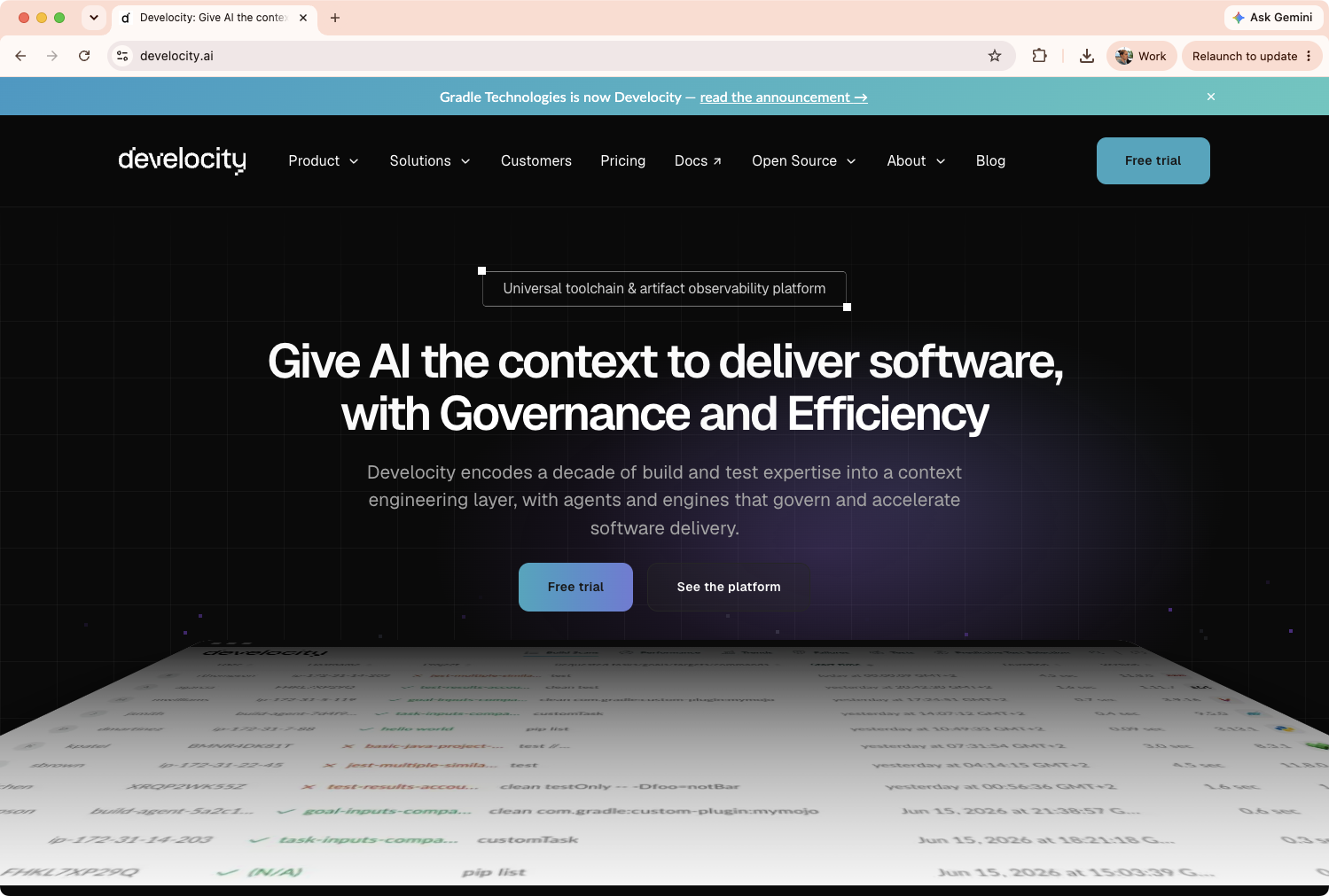
The company side of the house has, for close to a decade, built a commercial product called Develocity: a universal toolchain & artifact observability platform that works with Gradle, and also with Maven, Bazel, npm, sbt, and other toolchains that are conspicuously not Gradle. (The free Build Scan service is powered by Develocity). The company’s center of gravity has shifted toward that platform, and so the company took the product’s name. Gradle Technologies is now Develocity, at develocity.ai. The company’s announcement is here; this post is the view from the build tool’s side of the fence.
Anticipated frequently asked questions #
Was Gradle Build Tool acquired? No. This is a rename, which is about as uneventful as it gets for a corporate entity. No ownership changed, no money changed hands, no investors arrived or departed. We would rather work with the healthy skepticism open source communities bring to corporate announcements than against it, so here is an independent check: the legal entity is still Gradle, Inc.; only the operating name changed. See the copyright line in the footer of either website.
Is the license changing? No. Gradle Build Tool is Apache 2.0, was Apache 2.0, and remains Apache 2.0. We are aware that the “company associated with open source project announces news” pattern matches, in the current era, to “relicensing announcement to follow.” It does not apply here, and the incentives run the other way: the company’s commercial product is not an enterprise edition of the build tool, so there is no open-core lever to pull. Develocity sells observability and acceleration for many build systems; Gradle Build Tool is one of them.
Who pays the maintainers now? The same people who paid us last month, operating under a different name. The core engineering team of Gradle Build Tool consists of Develocity employees, works on the build tool full time, and continues to. Releases continue on their usual cadence. The roadmap, issue tracker, and source remain on GitHub.
What changed on gradle.org? Cosmetics, deliberately visible ones. If one of them is what brought you to this post, it worked as intended. You may have noticed “Gradle by Develocity” in search results and a more prominent link to Develocity on this website. This is the same convention you already parse without thinking elsewhere in the ecosystem: Next.js “by Vercel,” k6 “by Grafana Labs.” It exists to answer the question “who is behind this project?” at a glance, rather than in a footnote. Documentation, downloads, the community Slack, the forums, and everything else you actually use stay where they are.
What happens to gradle.com? It now redirects to develocity.ai and will continue to do so (no need to update bookmarks unless you want to). If you typed gradle.com, hoping for the build tool, you wanted gradle.org all along, which is part of why we wrote this post.
What changes in the build tool itself? Nothing, as a consequence of any of this. Version 9.x will be followed by more versions with larger numbers, produced by the same team, according to the same process.
Why we think this is good for the build tool, specifically #
You would expect us to say that, so here is the actual argument rather than the assertion.
The ambiguity ran in both directions, and the build tool paid for it too. When the company announced enterprise features, some fraction of readers heard “the build tool is going commercial.”
With the company named Develocity, “Gradle” is unambiguous again. Gradle is the build tool. Sentences about Gradle are sentences about the build tool. The trademark footnote in our footer can eventually retire with the quiet dignity it has earned.
The relationship itself has not changed, and we are not going to pretend otherwise: the build tool is stewarded by a company with commercial interests, as it has been from the start, and that arrangement has funded eighteen years of full-time engineering on a tool you do not pay for. What has changed is that the arrangement is now legible from the names alone, which is where most people encounter it.
Questions #
If any of this raises questions the FAQ above did not anticipate, the Community Slack and Forums are the right venues, and we will be in both. Corporate renames generate a long tail of small confusions (a stale link here, an old logo there), and reports of those are genuinely useful while we chase them down.
Your build, meanwhile, neither knows nor cares. As it should be.